

Introduction
Planning to learn how to use buses in London during your trip? London buses are one of the cheapest, easiest, and most scenic ways to travel around the city. Unlike the Underground, buses let you enjoy London’s streets while getting from one attraction to another.
Whether you’re visiting for the first time or simply want to save money on transportation, this guide explains everything you need to know—from paying your fare and finding the right route to using night buses and avoiding common mistakes.
By the end of this guide, you’ll know exactly how to use buses in London with confidence and travel around the city like a local.
Quick Answer
Can Tourists Use London Buses?
Absolutely. London buses are easy to use, accept contactless payment, and operate across the entire city.
Here’s a quick overview:
| Question | Answer |
|---|---|
| Do buses accept cash? | ❌ No |
| Can tourists use contactless cards? | ✅ Yes |
| Oyster Card accepted? | ✅ Yes |
| Daily fare cap? | ✅ Yes |
| Good for sightseeing? | ✅ Absolutely |
💡 Check-in Pick Insight
Many visitors assume the Tube is always the fastest option, but buses are often more enjoyable for short journeys because you can see London’s streets and landmarks along the way.
How to Use Buses in London: Understanding Bus Stops & Routes

One of the best things about London’s bus network is that it’s surprisingly easy to understand once you know how the system works. Every bus stop clearly displays the routes that serve it, while digital signs at many stops show live arrival times.
Unlike the London Underground, buses allow you to enjoy the city above ground, making them an excellent option for sightseeing between attractions.
How to Read a London Bus Stop
Most bus stops include the following information:
- Bus stop letter (such as Stop A or Stop G)
- Bus route numbers
- Destination of each route
- Live arrival times (at many stops)
- Area map showing nearby streets and attractions
When using Google Maps or Citymapper, the app will usually tell you both the route number and the correct bus stop letter.
For example:
- Bus: Route 24
- Destination: Pimlico
- Board at: Stop F
Simply wait at the correct stop and check the destination displayed on the front of the arriving bus.
💡 Check-in Pick Insight
Many first-time visitors only look at the bus number. In London, always check the destination displayed on the front of the bus, as the same route number operates in two directions.
London Bus Zones Explained
If you’re learning how to use buses in London, one of the biggest advantages is that you don’t need to worry about fare zones. Whether your journey lasts one stop or crosses several Underground zones, the bus fare remains the same. This makes buses one of the most affordable ways to travel around London.
Key facts:
- One flat fare applies to every journey.
- You don’t need to calculate zones.
- Transfers within one hour are covered by the Hopper Fare (explained later).
- You can travel surprisingly long distances for the same price.
💡 Check-in Pick Insight
Many visitors assume buses work like the Tube, but they don’t. The fare stays the same regardless of how far you travel, making buses an excellent choice for longer sightseeing journeys.
Boarding a London Bus
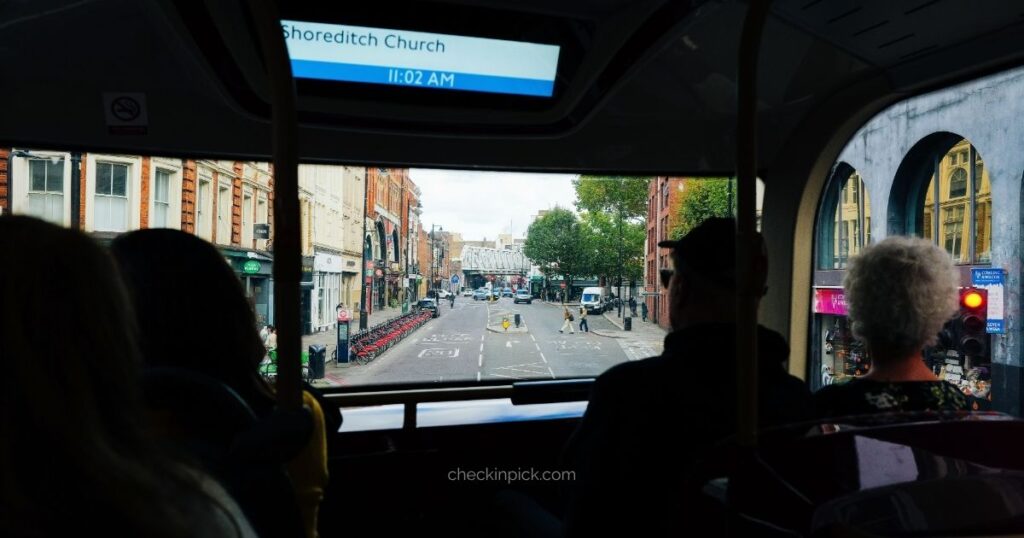
Learning how to use buses in London starts with knowing how to board correctly. Boarding a London bus is quick and straightforward.
When your bus arrives:
- Wait until passengers have exited.
- Board through the front door.
- Tap your contactless card, phone, smartwatch, or Oyster card on the yellow card reader.
- Find a seat or hold onto one of the handrails.
Unlike buses in some countries, you do not need to tell the driver your destination or purchase a paper ticket. If you’re using contactless payment, simply tap once when boarding.
There is no need to tap again when getting off.
💡 Check-in Pick Insight
Raise Your Hand to Stop the Bus!
Unlike in some countries where buses stop automatically at every stop, London buses may not stop unless someone is clearly waiting to board.
When you see your bus approaching, stand near the curb and raise your hand to signal the driver. This lets the driver know that you want to board, and they’ll usually stop if it’s safe to do so.
Many first-time visitors are surprised by this. If you simply stand back from the bus stop without signaling, the driver may assume you’re waiting for a different route and continue driving. A small wave or raised hand is usually all it takes.
Getting Off the Bus
Stopping the bus is easy.
When your stop is approaching:
- Press one of the red STOP buttons.
- A “Bus Stopping” message will appear.
- Exit through the middle or rear doors once the bus has stopped.
Unlike some cities, buses only stop automatically at certain major locations. If you don’t press the stop button, the driver may continue to the next stop.
💡 Check-in Pick Insight
Google Maps usually announces your stop, but I still like keeping an eye out the window. London buses are a great way to see the city, and it’s surprisingly easy to recognize major landmarks as you approach your destination.
How to Use Buses in London: Paying Your Fare
One of the first things you’ll learn when figuring out how to use buses in London is the payment system. You don’t need to buy a paper ticket before boarding, and buses no longer accept cash. Instead, simply tap your preferred payment method when you get on the bus.
Can You Pay Cash on London Buses?
No.
London buses became cash-free several years ago, so you cannot pay the driver with coins or banknotes.
Instead, use one of these payment methods:
- Contactless debit or credit card
- Apple Pay
- Google Pay
- Samsung Wallet
- Oyster Card
- Visitor Oyster Card
As long as you tap one of these payment methods when boarding, you’re ready to travel.
💡 Check-in Pick Insight
Many first-time visitors still carry cash expecting to pay the driver. Save yourself the hassle—just use a contactless card or your phone, which is how most Londoners pay.
Contactless vs Oyster Card
For most international visitors, contactless payment is the easiest option. Simply tap the same bank card or mobile wallet every time you board. An Oyster Card works almost identically but requires you to purchase and top it up beforehand.
| Contactless | Oyster Card |
|---|---|
| No purchase required | Must be purchased |
| Uses your bank card | Requires top-ups |
| Daily fare cap applies | Daily fare cap applies |
| Best for most tourists | Good if you don’t want to use your bank card |
If you’re unsure which option is best for your trip, read our Oyster Card vs Contactless in London (2026) guide for a full comparison.
London Bus Fares (2026)
London buses use a flat fare, meaning the price is the same regardless of how far you travel. Whether you’re riding for one stop or nearly an hour across the city, you’ll pay the same amount.
Current fare (2026):
| Journey | Fare |
|---|---|
| Single bus journey | £1.75 |
| Cash | Not accepted |
One of the biggest advantages of London’s buses is that you never have to worry about fare zones or distance-based pricing.
💡 Check-in Pick Insight
If you’re traveling across several neighborhoods, buses can sometimes be much better value than visitors expect because the fare stays exactly the same no matter how long the journey.
What Is the Hopper Fare?
The Hopper Fare is one of the best money-saving features for tourists. It allows you to take unlimited London bus and tram journeys within one hour of your first tap, all for a single fare.
For example:
- Tap onto Bus A at 10:00
- Change to Bus B at 10:25
- Change again to Bus C at 10:50
As long as each journey begins within one hour of your first tap, you won’t pay another fare. This makes buses particularly useful if your journey requires multiple transfers.
💡 Check-in Pick Insight
Many visitors don’t realize they can change buses for free within an hour. If Google Maps suggests two buses instead of the Tube, don’t assume it’ll cost more—it often won’t.
Daily Fare Cap
Like the Underground, London buses also have a daily fare cap.
Once your total bus fares reach the daily cap, you won’t pay any more for additional eligible bus and tram journeys that day.
The cap is calculated automatically when you use:
- Contactless payment
- Oyster Card
There’s nothing you need to activate—just remember to use the same payment method throughout the day.
For example, don’t switch between your physical bank card and Apple Pay, as they’re treated as separate payment methods.
💡 Check-in Pick Insight
One of the most common mistakes tourists make is switching between different cards or devices. Stick with the same contactless card or mobile wallet all day to make sure the daily cap works correctly.
How to Use Buses in London at Night: Night Buses & Practical Tips

If you’re wondering how to use buses in London after the Underground closes, Night Buses are the answer.
Using London’s Night Buses
Knowing how to use buses in London at night can save both time and money, especially after the Underground has closed.
Night Bus routes are identified by the letter “N” before the route number (for example, N11 or N24) and operate throughout the night on many major routes across London.
Night Buses are especially useful if you’re visiting popular nightlife areas such as:
- Soho
- Covent Garden
- Leicester Square
- Shoreditch
- Camden
The fare is exactly the same as a regular London bus, and you can pay using contactless payment or an Oyster Card.
💡 Check-in Pick Insight
Night Buses can look confusing at first, but they’re often the easiest and cheapest way to get back to your hotel after an evening out. Just double-check the destination before boarding, as some night routes differ slightly from their daytime counterparts.
Accessibility on London Buses
Another helpful part of learning how to use buses in London is understanding the accessibility features available on every bus.
Most buses include:
- Low-floor boarding
- Wheelchair spaces
- Priority seating
- Audio stop announcements
- Digital display screens showing the next stop
Parents traveling with young children will also find buses convenient because most can accommodate folded strollers, and many allow open strollers when space is available. If you have heavy luggage, buses are generally manageable, but avoid traveling during rush hour when they can become crowded.
Bus Etiquette in London
Londoners generally follow a few simple unwritten rules when using buses.
Following these customs will make your journey smoother:
- Let passengers leave before boarding.
- Move further inside the bus if space is available.
- Offer priority seats to elderly passengers, pregnant women, or those with disabilities.
- Keep conversations and phone calls reasonably quiet.
- Avoid blocking doors with luggage or backpacks.
These small gestures help keep London’s busy bus network running efficiently.
Common Mistakes Tourists Make
Even after learning how to use buses in London, first-time visitors still make a few common mistakes.
Waiting at the Wrong Bus Stop
Many routes stop at different bus stops on the same street.
Always check the stop letter shown in your navigation app.
Boarding the Wrong Direction
The same route number operates in both directions. Always check the destination displayed on the front of the bus before boarding.
Forgetting the Hopper Fare
Many visitors unnecessarily choose the Underground because they think changing buses will cost more. If your transfers are within one hour, the Hopper Fare usually covers them without an additional charge.
Switching Payment Methods
Using your physical bank card for one journey and Apple Pay for the next counts as two separate payment methods. Stick to the same card or device throughout the day to benefit from fare capping.
💡 Check-in Pick Insight
Google Maps and Citymapper are both excellent for planning bus journeys, but I always take a quick look at the destination shown on the front of the bus before boarding. It only takes a second and can save you from traveling in the wrong direction.
Frequently Asked Questions
Are London buses free?
No. Adults must pay the standard fare unless they’re eligible for a concession or free travel scheme.
Can tourists use London buses?
Yes. Tourists can simply use a contactless bank card, mobile wallet, or Oyster Card.
Do I need to tap out when leaving the bus?
No. You only tap once when boarding.
Are London buses safe?
Yes. London buses are generally very safe and are used by millions of passengers every day. Like anywhere else, keep an eye on your belongings, especially during busy periods.
Is the upper deck worth it?
Absolutely. Sitting on the upper deck at the front is one of the best ways to enjoy views of London’s streets and landmarks, especially if you’re sightseeing.
How much does it cost to use buses in London?
Once you know how to use buses in London, you’ll find that every bus journey costs a flat fare regardless of distance, making buses one of the cheapest ways to travel around the city.
How do I use buses in London as a tourist?
To use buses in London, simply board through the front door, tap your contactless card or Oyster Card, and check the destination displayed on the front of the bus before boarding.
Final Thoughts
Learning how to use buses in London is one of the easiest ways to save money, see more of the city, and travel like a local during your visit.
With contactless payment, flat fares, and an extensive network covering almost every corner of the city, buses are an excellent choice for both first-time visitors and returning travelers.
Once you’ve learned how to use buses in London, you’ll be able to explore the city confidently like a local.
After learning how to use buses in London, these guides will help you plan the rest of your journey:
- London Underground Guide (2026): Best Ways to Pay for the Tube
- Oyster Card vs Contactless in London (2026)
- London Travel Tips (2026): 25 Smart Tips Every Tourist Should Know
- London Underground Guide: Best Ways to Pay for the Tube (2026)

Welcome to CheckinPick. We create practical travel guides for visitors planning trips to London and other destinations.
Our editorial team focuses on useful, up-to-date information about transportation, accommodation, attractions, fares and travel planning. We research information using official sources and reputable travel resources, and we update our guides when important details change.
Our goal is to make travel information easier to understand and more useful for real-world trip planning.